Mechanism
WAF ↔ Wear Trade-off
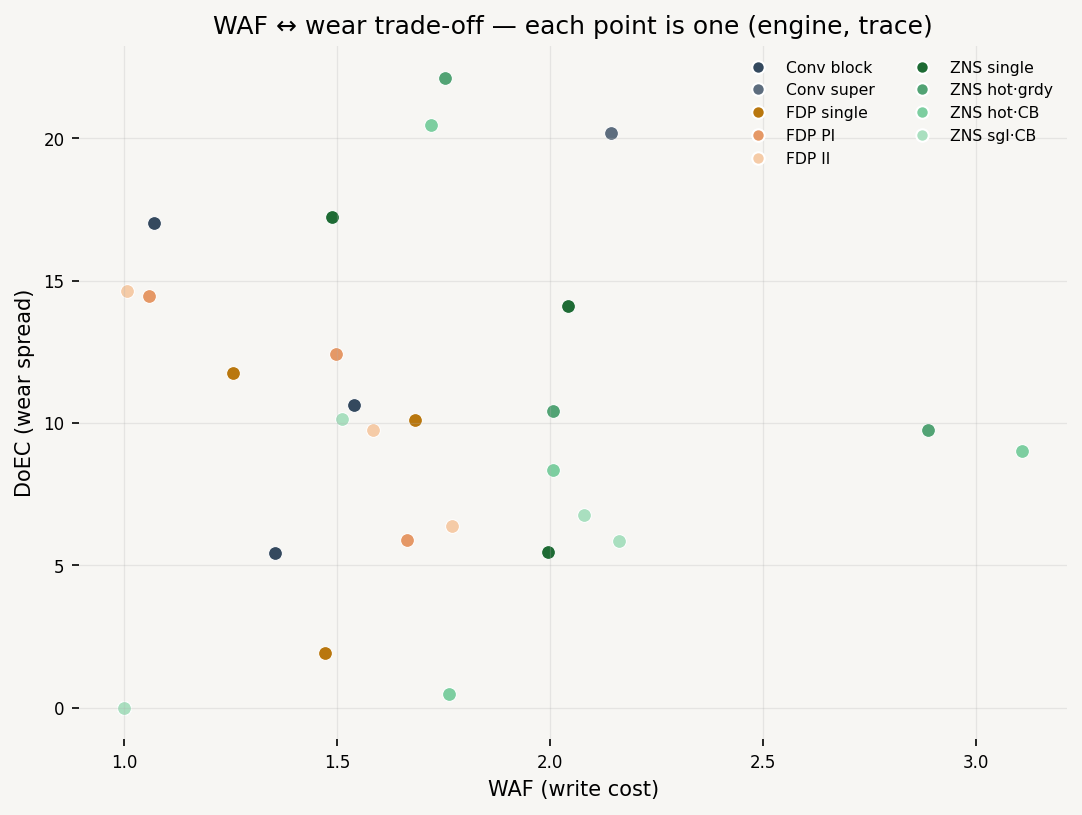
Our finding. Write amplification and wear-evenness do not move together: engines at similar WAF can differ sharply in wear spread. Conventional superblock GC lands at high WAF and high wear on real traces; FDP-PI/II cluster at low WAF with moderate wear.
How this helps our work. It frames the design decision as a two-objective trade-off and identifies, per (engine, trace), which policies sit on the efficient frontier and which are dominated — the practical takeaway an FTL designer needs from the study.
What it shows. Each point is one (engine, trace): WAF (write cost) on the x-axis vs DoEC (wear spread) on the y-axis, coloured by engine.
What we found
- Low WAF does not guarantee even wear. The cloud of points is not a straight line — engines at similar WAF can differ markedly in DoEC, and vice-versa.
- Conventional superblock GC lands at high WAF and high wear spread (worst of both) on real traces; FDP-PI/II cluster toward low WAF with moderate wear.
- The frontier is what an FTL designer optimises: this plot names, per (engine, trace), who is on it and who is dominated.