Placement Effect — FDP Isolation & ZNS GC
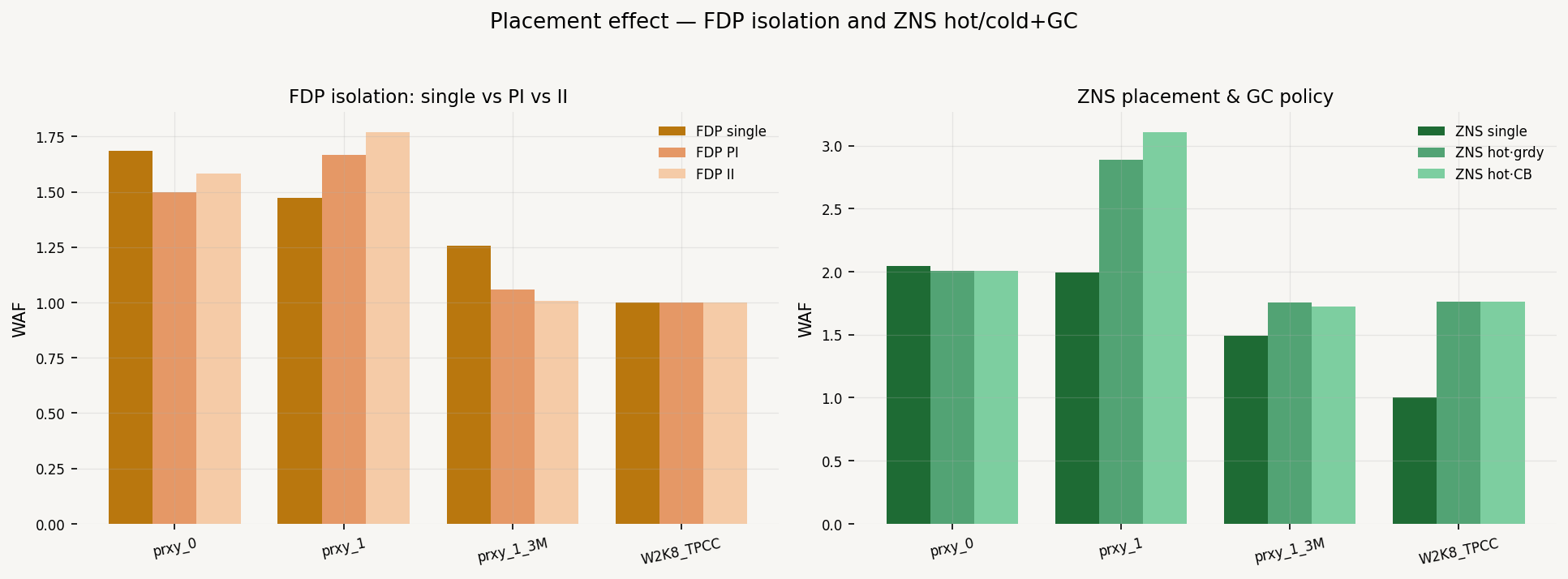
Our finding. Placement isolation is a workload-dependent tool, not a free win. FDP-PI lowers WAF on skewed, sufficiently-aged workloads (prxy_1_3M, zipf, 80/20) where there is reuse skew to exploit, but on uniform or short traces its per-RUH GC reservation fragments the over-provisioning and can raise WAF; FDP-II is the most robust across workloads. ZNS hot/cold helps on zipf yet backfires on prxy_1 (2.89 vs 1.99 single) through a cold-pollution feedback loop that cost-benefit GC does not fix.
How this helps our work. This is the actionable design guidance the simulator exists to produce: which placement scheme to use for which workload, and the failure modes to avoid. Paired with the Mechanism graph, each outcome is explained through valid-at-reclaim.
What it shows. Left: FDP single vs Persistent Isolation (PI) vs Initial Isolation (II). Right: ZNS single-stream vs hot/cold separation under greedy and cost-benefit GC.
- FDP-PI helps on skewed data, hurts on uniform: prxy_1_3M single 1.26 → PI 1.06 → II 1.01; 80/20 single 1.16 → PI 1.10; but uniform single 1.54 → PI 1.75 → II 2.21 (isolation reserves OP that a no-skew workload can't repay).
- FDP-II is the most robust across workloads — best on skewed, least-bad on uniform among the isolating modes.
- ZNS hot/cold can backfire: helps on Zipf (single 1.18 → hot/cold 1.06) but hurts badly on prxy_1 (single 1.99 → greedy 2.89 → cost-benefit 3.11) — cold-pollution feedback that cost-benefit GC does not fix.