What Predicts WAF — Mechanism Scatters
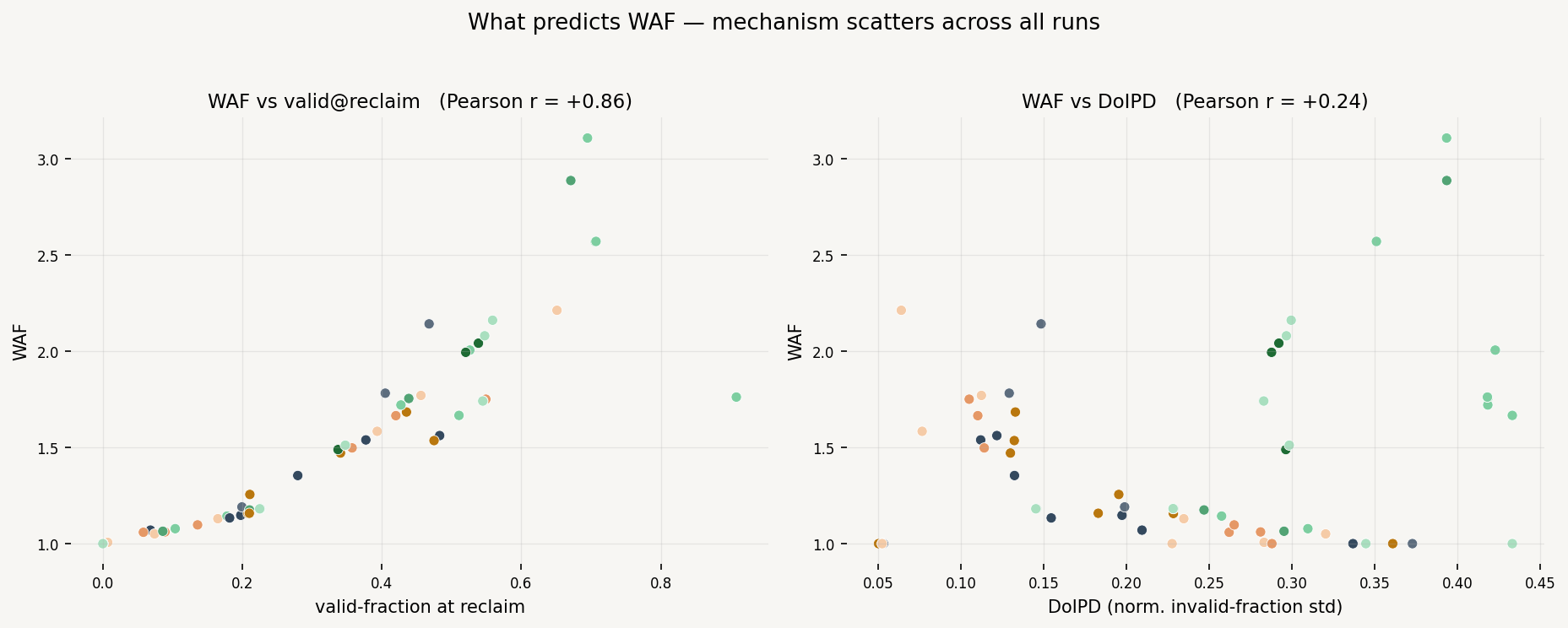
Our finding. Write amplification is governed by a temporal property — whether a unit's pages die together — far more than by the spatial spread of the layout. Over all 69 runs, WAF vs valid-at-reclaim gives r = +0.92, while WAF vs invalidity dispersion (DoIPD) gives only r = +0.55.
How this helps our work. This is the analytical backbone of the paper: it names the quantity to reason about and to target. Reducing write amplification means arranging for pages to be invalidated together (temporal placement) — exactly what FDP isolation and ZNS hot/cold separation attempt — and this one picture explains why some of them succeed and others backfire.
What it shows. Every (engine, trace) run as a point, WAF on the y-axis. Left: vs valid-fraction-at-reclaim (the temporal GC cost). Right: vs DoIPD (the spatial invalidity dispersion).
- Temporal beats spatial: WAF vs valid-at-reclaim r = +0.92; WAF vs DoIPD r = +0.55 — over the same 69 runs.
- This gives the paper its explanatory variable: write amplification is set by when pages die (do a unit's pages die together?), not by how disordered the layout looks at any instant.
- It directly explains the placement results — policies that group same-lifetime data (e.g. FDP-PI on skewed loads) drive valid-at-reclaim down, and WAF falls with it.