Valid-Fraction-at-Reclaim (the WAF mechanism)
Our finding. The valid fraction of a unit at the moment GC reclaims it is the quantity that sets write amplification. Across all 69 runs it tracks WAF at Pearson r = +0.92 — tighter than any spatial dispersion measure. WAF is governed by when a unit's pages die together (a temporal property), realised as how empty the unit is when it is reclaimed.
How this helps our work. It gives us a single, mechanistic, directly-measurable lever that explains why one placement policy beats another: good policies push reclaims into the near-empty band, which is cheap to migrate. Every WAF result in the paper can be read back to this one cause.
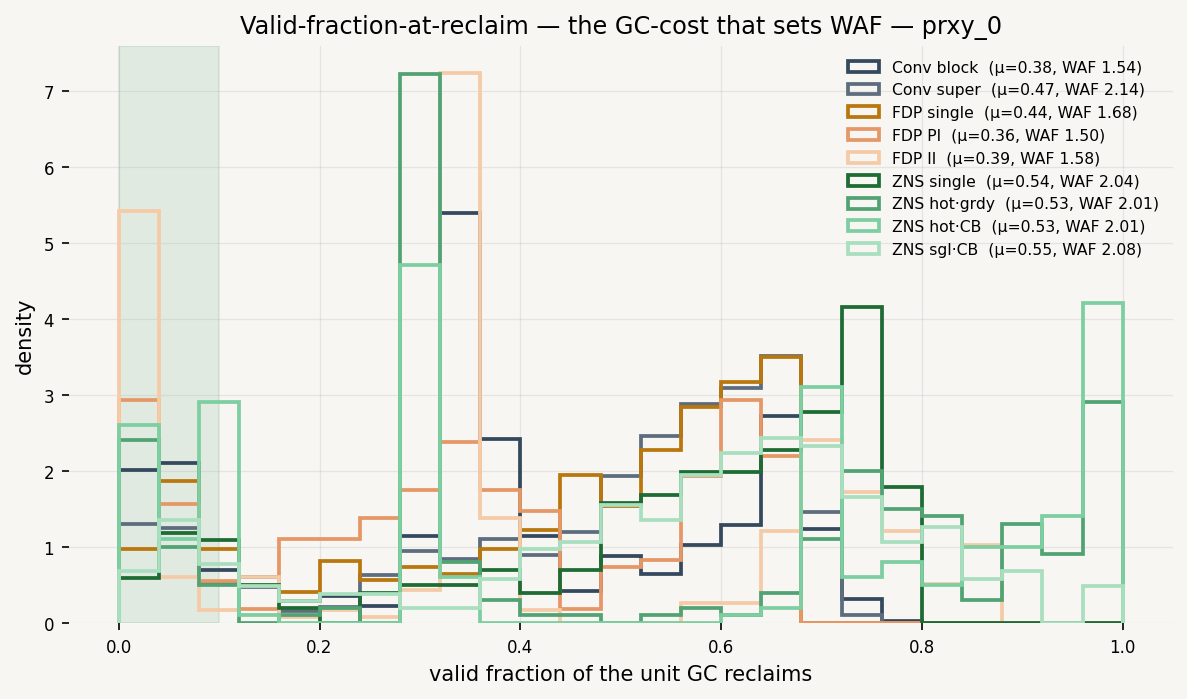
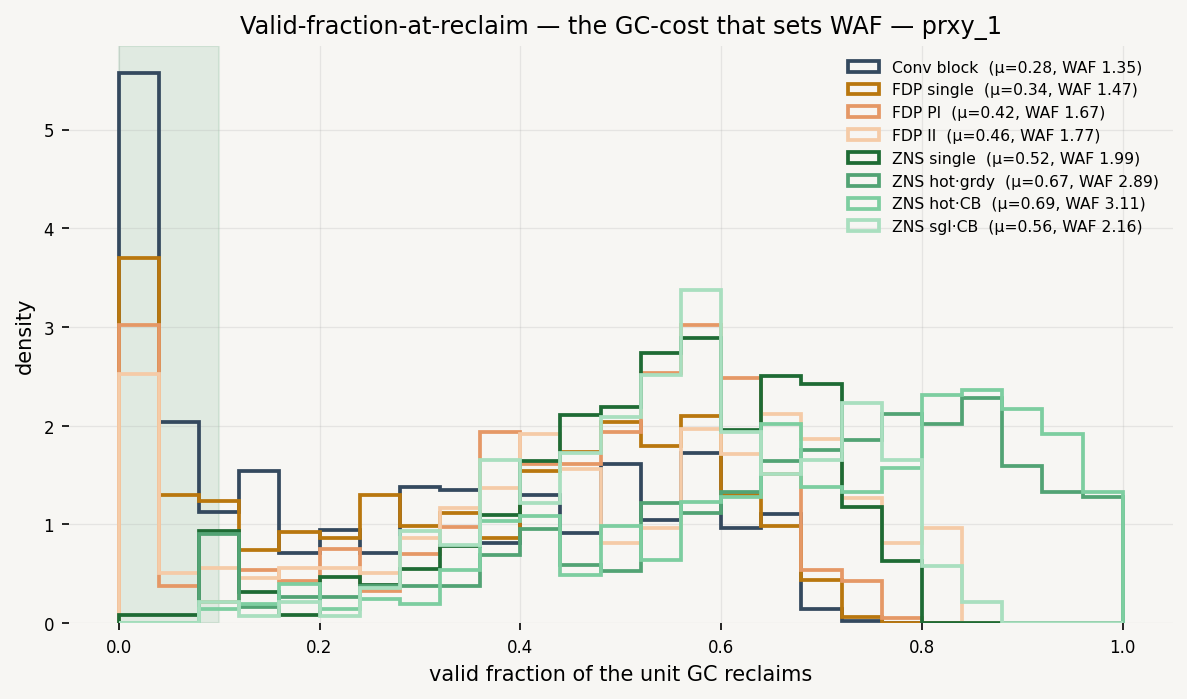
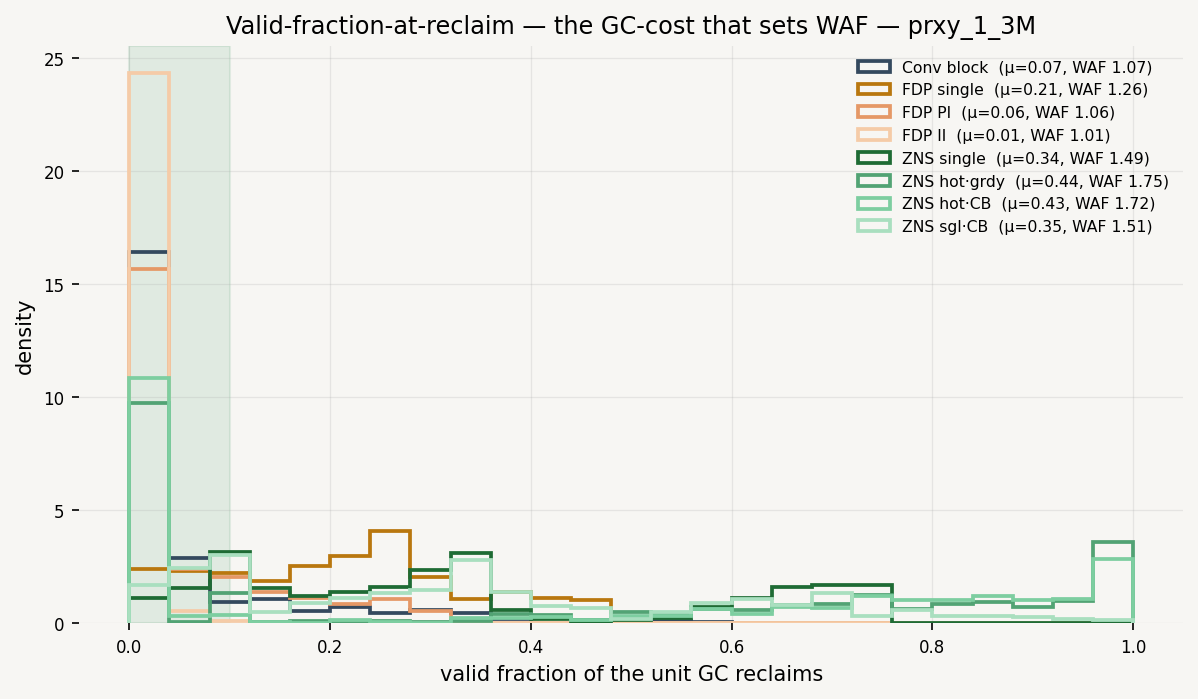
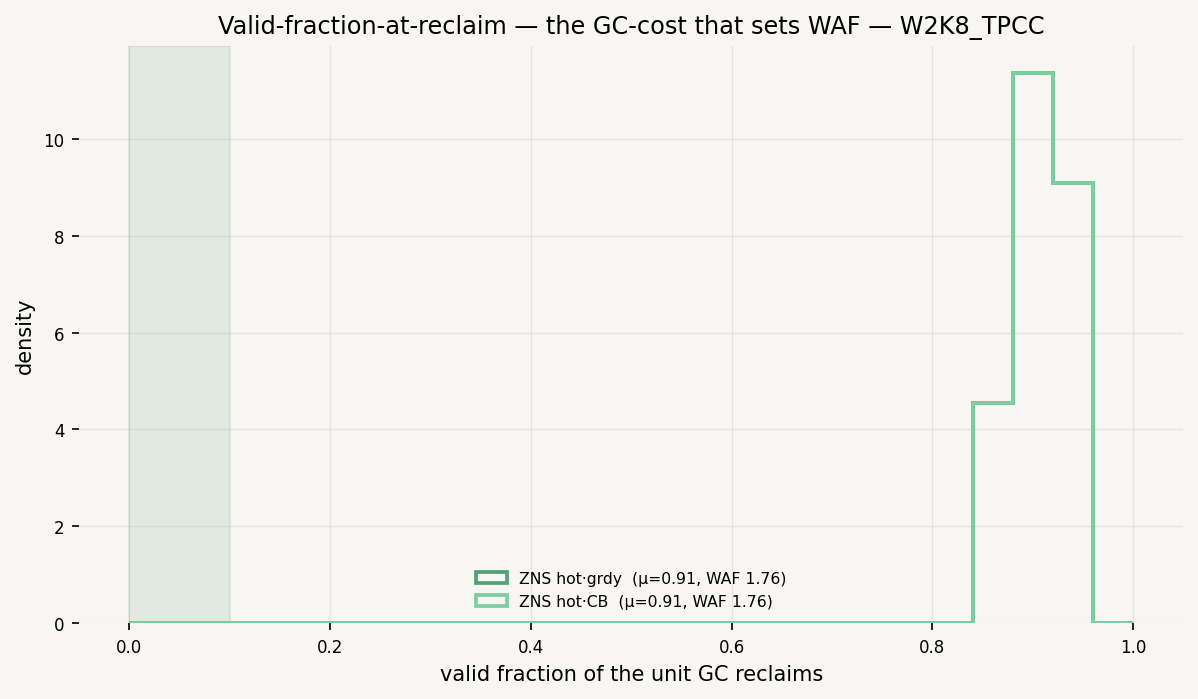
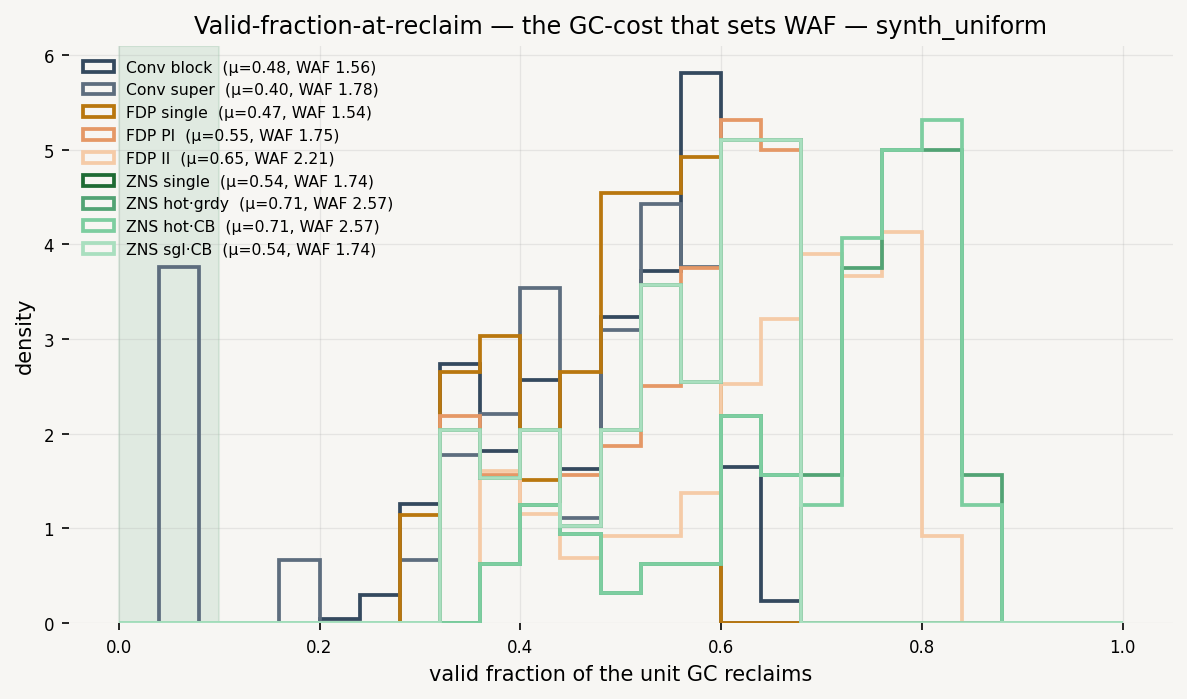
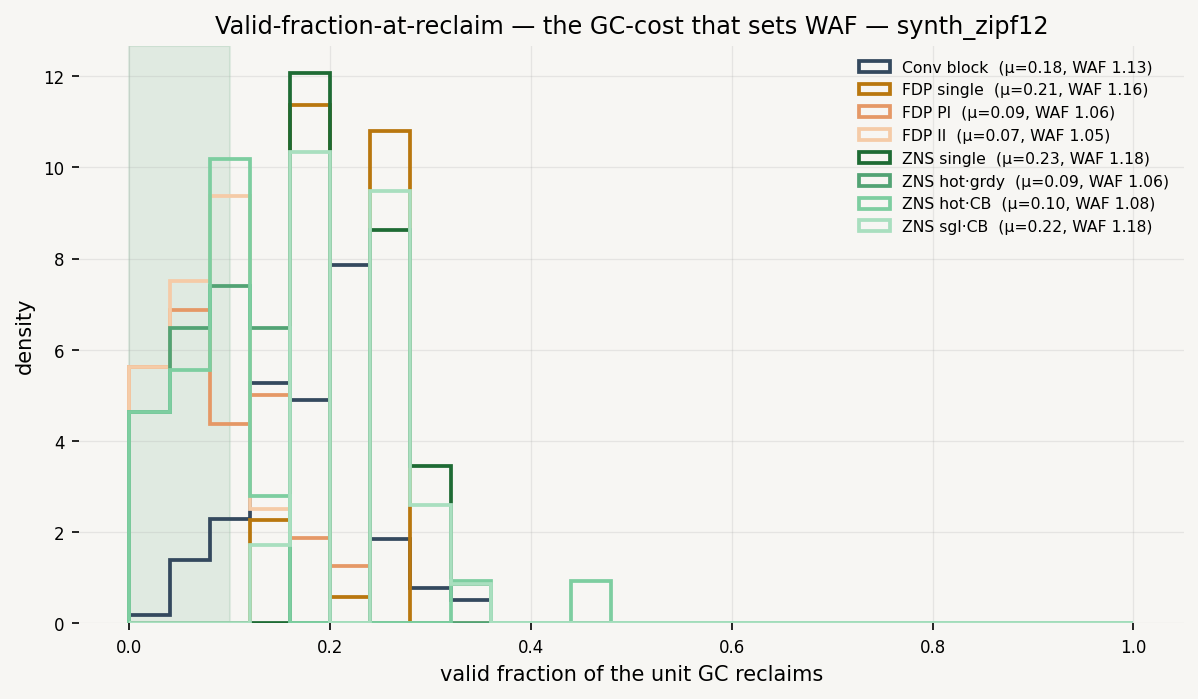
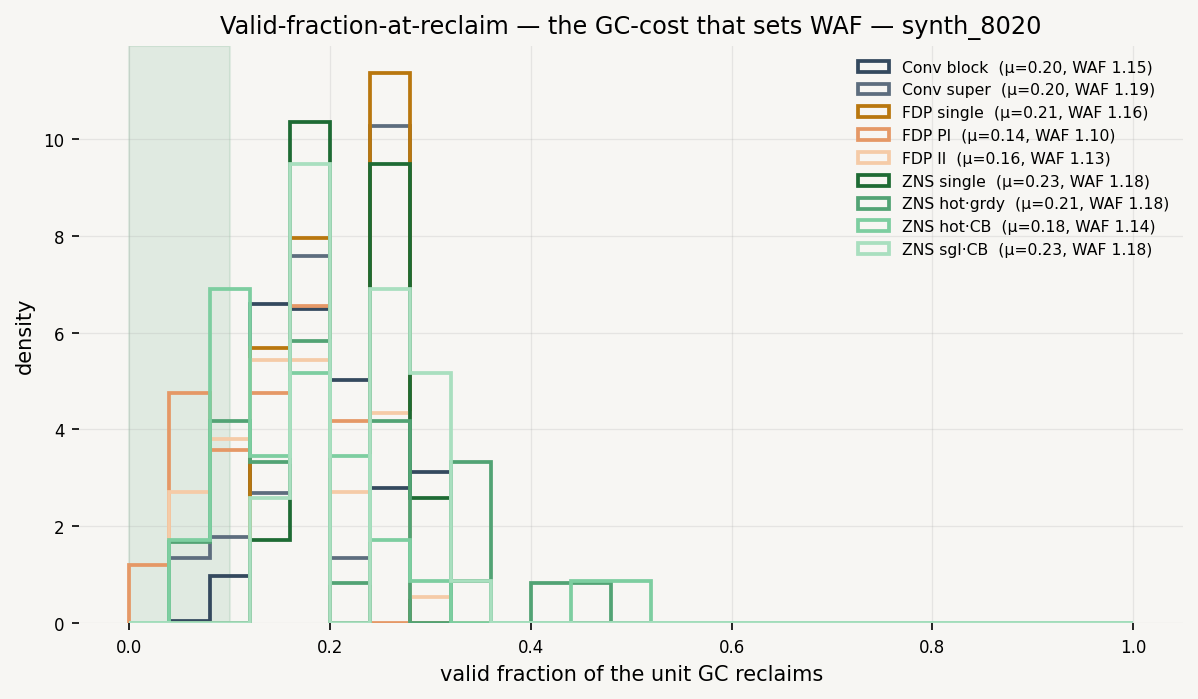
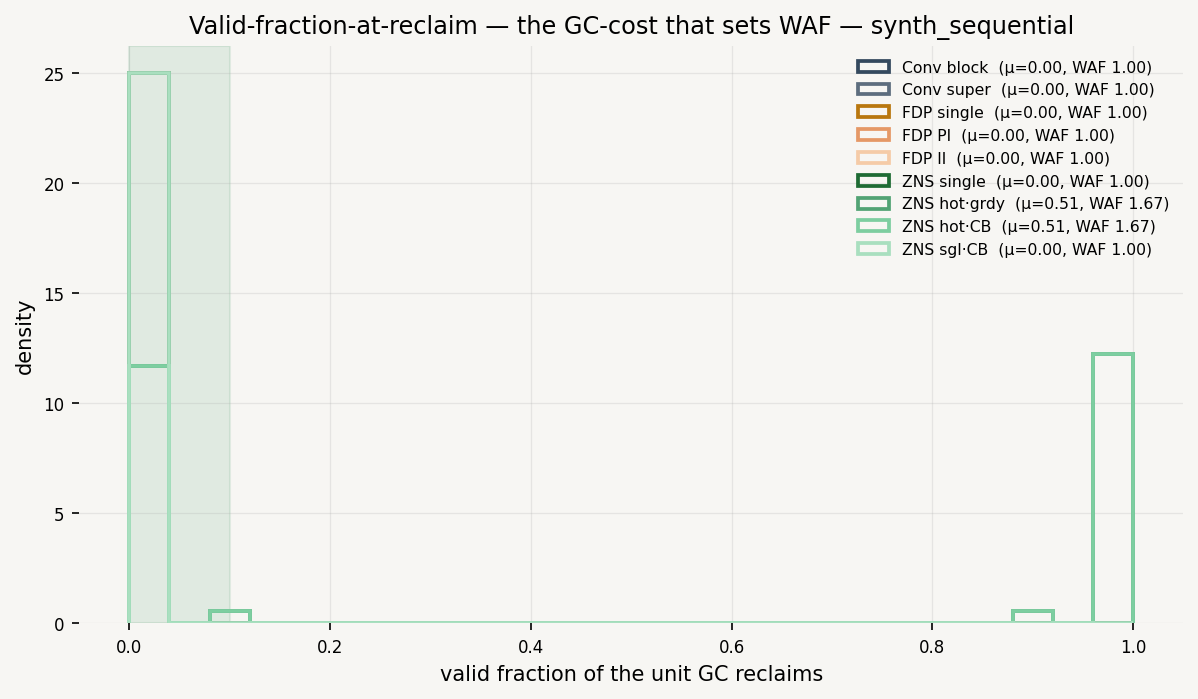
What it shows. The distribution of victim valid-fraction at reclaim. A unit taken at 10% valid costs almost nothing to migrate; one at 60% forces copying most of its pages. The green band marks the near-empty (“free”) victims a good policy maximises.
- The correlation is tight: r = +0.92 between mean valid-at-reclaim and WAF across all 69 runs.
- Concrete points: prxy_1_3M FDP-PI reclaims units only 5.8% valid → WAF 1.06; 80/20 FDP-PI 13.6% valid → WAF 1.10; prxy_0 conv 37.7% valid → WAF 1.54; uniform conv 48.3% valid → WAF 1.56. Higher valid-at-reclaim, higher WAF, every time.
- Good policies push reclaims into the near-empty “free” band (<10% valid); uniform workloads can't, so they pay the most.