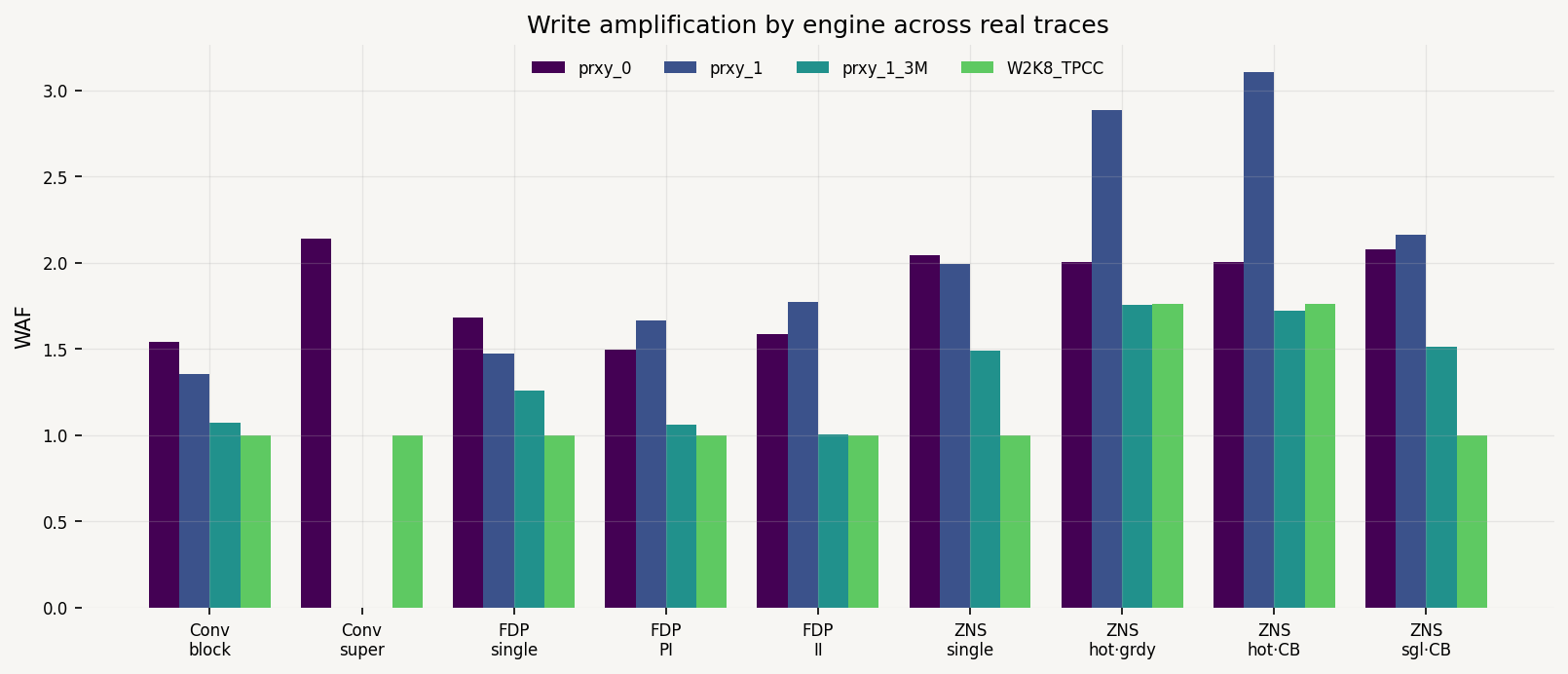
Write Amplification by Engine across Real Traces
Our finding. No single engine wins across workloads. Placement schemes (FDP, ZNS) reduce write amplification on skewed, reused data but can cost extra on write-once or uniform workloads — the benefit is workload-dependent, not universal.
How this helps our work. This head-to-head is the map that motivates the rest of the study: it shows where each placement policy pays off and sends us to the distribution and mechanism analyses to explain why.
What it shows. WAF for all nine engine variants on each real trace. Lower is better; grouped bars compare engines within a workload and across workloads.
The nine engines.
| Engine | Data placement | Garbage collection |
|---|---|---|
| Conventional · block GC | page-mapped FTL, no hints | reclaims one block at a time, greedy (fewest-valid victim); whole OP is one pool |
| Conventional · superblock GC | page-mapped FTL | reclaims a whole line (one block per plane) together — mirrors FEMU's erase granularity |
| FDP-single | one placement handle — all host writes to one RU stream | device-managed, greedy on reclaim units (superblocks) |
| FDP-PI (Persistent Isolation) | 2 handles: hot (overwrites) / cold (first writes) | GC copies stay in their own RUH → pure streams; reserves per-RUH GC headroom |
| FDP-II (Initial Isolation) | 2 data handles, hot/cold | GC copies pooled into one shared GC-RUH — pools the slack, robust at low OP |
| ZNS-single | host-managed, single append stream | host GC, greedy victim zone (device does no GC) |
| ZNS hot/cold · greedy | 2 zones: hot / cold | host GC, greedy (fewest-valid zone) |
| ZNS hot/cold · cost-benefit | 2 zones: hot / cold | host GC, F2FS-style age×(1−u)/2u victim — defers stable cold zones |
| ZNS-single · cost-benefit | single append stream | host GC, cost-benefit victim (isolates the GC-policy effect from the hot/cold effect) |
Why conventional block GC looks strong. It uses the finest reclaim granularity (fewest valid pages migrated) and no isolation overhead (the whole over-provisioning is one shared pool), so at a generous OP it is hard to beat. Note this is partly a modeling idealization — real multi-plane NAND cannot erase a single block, so the hardware-faithful conventional baseline is the superblock variant.
- No universal winner. On the aged prxy_1_3M trace the best is FDP-II (1.01), then FDP-PI (1.06) and conventional block (1.07); ZNS variants are highest (1.49–1.75).
- Write-once workloads (TPC-C, sequential) sit at WAF 1.00 for every in-place engine — no rewrite means no GC. Only ZNS hot/cold pays migration there (1.67–1.76).
- Short, bursty prxy_1 is the hardest: ZNS hot/cold blows up to 2.89–3.11, while conventional block stays 1.35.